

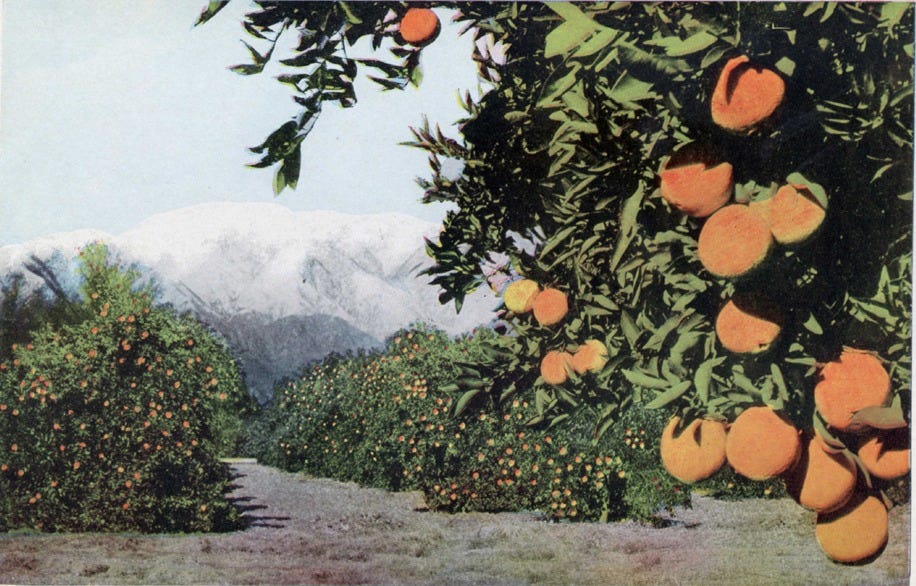
When Echo Mountain burned, only the hyacinth macaw could escape. He had come to town after the ostriches and before the peacocks, with a brief career greeting consumptives and reformed gold-diggers at the summit before the century turned so quick the whole place caught fire. He spoke a fair bit of Portuguese, decent Tongva, and passible Spanish. English he learned from a yellow-naped amazon who lived on Millionaire’s Row.
Through the bars of the amazon’s gilded cage, the macaw often told her about when he’d seen the live oaks felled and citrus groves planted, watching the valley grow from oranges to empires that stretched all the way to the edge of the continent. Sometimes, he talked about that world beyond the ocean, where the blue stretched into a wilder green thrumming with Choro mandolins. The macaw proposed helping the yellow-naped amazon escape so they might reach this faraway world together, but she could not fathom what lay beyond the limits of her imagination.
So the macaw stayed. He was given a perch in the big house where the yellow-naped amazon remained caged and became acquainted with the family who lived there—they were called the Monroes. The macaw stayed up late with the father, and sometimes they would have discussions in the dim light about mountains and jungles and the present fashion for feathers. The father, Leland Monroe, told the macaw things he didn’t dare tell anyone else, perhaps because he didn’t think a bird could really understand.
But the macaw knew straight away that the Monroe family wasn’t like all the old moneyed lace, diamonds, and sealskin that had ascended Echo Mountain in a funicular just to look down at everyone else through the soft desert haze destined to seduce onlookers into the mirage. The thick trees lining the boulevards at the base of the mountains were the start of this mirage, suggesting verdant Edens and a land without without. They had been planted there from faraway seeds, turning the valley below the mountains into an accumulation of transplants. These belonged there by sheer force of belief in rights signed onto paper made from wiser trees that had been chopped down in an earlier name of destiny.
To people, the macaw could only repeat what he had heard, which was why they called him Echo, like the place he’d flown down from. His new home beneath the mountain was not a place of pasts. The people there seemed to have short memories, but sometimes the macaw liked to think like them, content with the rose and citrus, wealth and promise. Even false Edens were beautiful, so Echo settled in and came to understand three secrets that defined his new family’s fate: where the money had come from, why the father was dying, and how a new addition to the household would soon set everything ablaze.
**********
It all started that early morning in 1905 when the brisk sunrise air carried the usual perfume of rose and neroli through the open windows. It had been the same kind of morning five years prior when Echo Mountain’s cloud hotel disintegrated into ash. As Echo, the macaw, flew through the high up smoke and down into the clear, he’d seen the clouds burning and watched the whole sky swallowed up by the blazing orange. This morning’s sky, however, was pale pink as a rose, a color so gentle no one realized it would be the harbinger of great change. That could merely have meant the season, as spring was blooming into summer. But this was also the day that Sadie Reyes would knock at the front door.
On this neroli morning, Leland Monroe had woken to the name Comstock again. It had come, soft and swift as a whisper through the tide pulling him out of that morning’s slumber. This was precisely the third time in his life that he had heard that word whispered through a dream. This time, there was nothing left for Comstock to take except the life slowly fizzling out of Leland’s veins.
Death, however, was an inevitable fact of his near future, and Leland’s children had developed a peculiar anesthetic to the grief and worry that accompanied the degradation of their father’s health. Nathaniel and Cordelia Monroe, ages twenty-seven and nineteen, had been resigned to the inevitable for so long that they’d forgotten it was coming, and sooner than they might expect. Which was why it was still going to surprise them. They would recognize only too late how much they had relied on their father, as children are wont to do. And they would realize, in the cool dusky mornings which would not change post death, that they knew very little about where they had come from. False forevers thrived in that verdant valley of their upbringing, peeking through the timeless haze which obscured anything that might have come before. Nathaniel and Cordelia Monroe had never heard the name Comstock, and would never know their father’s curse.
They had risen peacefully with the morning glories while Leland awoke panicked in his bed. Panicked with such certainty that it quickly became resignation. The beginning of the end was surprisingly easy to accept. Leland pushed himself upright against the pillows, benumbed in his awe of the patterns of life.
Echo was at the foot of the bedframe, dozing on his habitual perch. He had one eye closed and one eye open, a disconcerting posture suggesting the bird was asleep, but simultaneously on guard.
“You didn’t say anything, did you?” Leland asked the bird.
Echo blinked awake and shook out his feathers. He muttered or grumbled but said nothing more. Leland was assured, then, that Comstock had been his own nightmare.
Oh, how strange it all had been, and how normal it all became—or was it the other way around? It didn’t seem so long ago that Leland had been unwrinkled and beardless, waking to that name whispered for the first time over his plank bed near the shipyard on the Chesapeake Bay. His memories, lately, were older than they had ever been, of the earlier days when hard work had been the only way to make his living.
When Leland first heard that whisper, he’d been a young man of five-and-twenty. For weeks, the name Comstock taunted from lips to ears with visions of easy riches. It heckled silver promises from the newspapers beckoning from a boom town out west called Virginia City. But Leland’s was not a quicksilver scheme like the others. The name had been whispered in his dream before it was on everyone’s lips. Despite his promising sheer merit career managing Transatlantic imports, he left everything to seek Nevada’s Comstock Lode with all the other aspiring miners, simply because the name ringing in his ears sounded like destiny. 1859 had been a time when destiny and all its false pomp was not to be taken lightly.
And destiny found him there, in a way. Except that her name was Lenora and she had stolen happiness from the unlusted wealth that was to follow. Not that he hadn’t been happy since. He had simply lost all idealism to become a man of business. He feared the only recognizable feature of that young dreamer headed west on a hunch in that river of certainty were his brown eyes, the only things about him that remained as dark and beseeching as they had always been.
Just then, a mental elegy of all woes and grievances would have been morbidly nostalgic, and it seemed trite to detail how unlucky he felt despite having settled onto Millionaire’s Row. Nothing, Leland concluded, was ever enough. That was the true curse beyond all Comstock delusions. It was, after all, another day in paradise in the crowning jewel of the valley. The poppies in the foothills were blooming into a golden veil, the air was rich with roses and—
A knock at the door pulled Leland out of his contemplation and startled Echo on his bedframe perch.
“Are you awake, Mr. Monroe?” A muffled voice queried on the other side of the door. “Dr. Wheatley’s here.”
The word “doctor” was enough to send Leland into a sudden coughing spasm, but that was typical for ten in the morning. Wheatley was right on schedule. And wasn’t it all just a game of time?
“Come in, Scottie.” Leland wheezed. If he were a man of greater decorum, he might have referred to the housekeeper more formally as Ms. Havescott. But since she was a humorless employee with not a stitch out of place, he took great satisfaction in a more congenial appellation, especially on the occasions when it prompted her to break her characteristic no-nonsense façade.
Scottie entered the room, her familiar tidiness a comfort against the terror that had startled Leland awake. “Shall I send him up?”
“Who?” Leland rasped, a sudden chill thrilling up his spine.
“Dr. Wheatley, of course.”
“Of course.” Leland reached for the ever-present glass of water on his bedside table. He gulped down his worry and felt his throat soothed. He’d been afraid Scottie might say Comstock, but he was also still half asleep. “Very well.”
After the housekeeper disappeared from the room, a long stride coming up the stairs soon replaced her rapid scuffling down the hall. The polite knock on the door left ajar announced Dr. John Wheatley a moment before he entered. Despite being a man no more than forty, his brow was permanently creased with something between concentration and worry.
“Good morning,” he said as he pulled a stethoscope from his handbag.
“Good morning,” the macaw grumbled back in his warbly imitation of the human voice.
“Good morning, Echo,” Wheatley muttered. “Why do you keep that blasted parrot around, Mr. Monroe?”
“At least he’s polite.” Leland winced with the effort to sit up straighter in bed so that Wheatley could listen to his heart and lungs, a choreography they’d rehearsed daily for the last decade. “And I maintain the conviction that any man who’s seen me in my underclothes reserves the right to call me Leland.”
“Old habits, I suppose.” Wheatley put his stethoscope away. “How is everything?”
“No need to go down the checklist, Doc. We both know what’s coming. I’d like to be lucid enough to confront my demons before giving in.”
“You’re too prosperous a man to be living with that kind of regret.”
“You think peace begets prosperity? Or prosperity peace?”
“I suppose I simply hoped,” Wheatley parried as he rummaged through his bag again, “that achieving great wealth would bring a man some form of happiness.”
“Money is curing the symptoms, not the cause.”
“Well, if you’ve resigned yourself to dying, there’s nothing more I can do for you. But we can try upping the mercury dose. It does seem to be having a positive effect.”
Dr. Wheatley seized what had been eluding him at the bottom of his bag and pulled out a small glass bottle full of pills glimmering the same indigo blue as Echo’s plumage. The macaw torqued his neck curiously to watch the doctor skirt around to Leland’s bedside table and place the bottle beside an identical, half-empty one. “You can continue with three blue mass tablets daily, but perhaps an injection every now and then would calm things even more.”
“I think you’re more interested in killing than curing me.”
“As you know, there is no cure.”
“Nay!” Leland scoffed playfully. “I know the cure. I made my millions off it.”
“Orange juice won’t do you much good,” Wheatley smirked, “but it won’t do any harm either.”
“Is that what you’ve been told?” Leland’s laughter incited another round of hoarse, hacking coughs. “Anyone who knows what’s good for them in this town cries orange when they’re talking gold. But the citrus here is the only gold in abundance that’s made no one rich.”
He might have gone on, but more coughs stole the words from his throat.
“I think you’re entering another one of your deliriums,” Wheatley said coolly. “And I don’t like the sound of that cough.” For the third time, he plunged a hand into his bag. “I think I’ve still got some Heroin syrup in here. That should keep your coughing to a minimum.”
“Whatever you say, Doctor.”
“Whatever you say,” the macaw echoed.
Leland’s eyes followed Wheatley as he placed another bottle next to the blue pills. “You’re not proffering me more snake oil?”
“This is a certified cough suppressant,” Wheatley assured him. From the folds of his coat, he produced a spoon and poured a dose of the syrup into its basin. He offered it to Leland, who opened his mouth obligingly.
After a wince, he swallowed. “I never thought it would be my deathbed that had me feeling like a little boy again.”
“Have you enough youth and vigor to head downstairs to breakfast?”
“I suppose.” Leland pushed away the covers. “Would you help me up?”
Wheatley carefully eased Leland upright and steadied him onto his feet, but he was neither small nor light. It took a great flurry of balance and precision to get him wrapped in the paisley, silken housecoat draped over a nearby chair and fitted with a walking stick propped near the door.
“That’s new,” Wheatley observed.
“I usually keep it downstairs.” Leland brandished the stick, fine mahogany with a sterling handle. “This isn’t for walking at all. A man must have style.”
At that moment, Echo took off from the bed frame and descended onto Leland’s shoulder, forming the crowning accessory to his ensemble.
Wheatley chuckled good-humoredly as Leland crooned at the macaw and made a show of exiting the room. But the doctor could not help noticing that his patient leaned a little heavily on the cane as he shuffled down the hall.
They parted ways in the foyer, where Scottie escorted Wheatley out as Leland made his own way into the paneled dining room. There he found his son, Nathaniel, stretched out leisurely at the head of the table, his face obscured by the morning paper.
At the sound of approaching footsteps, Nathaniel lowered the paper to the table, revealing his dark, furrowed brows and eyes a shade still darker. He was the image Leland had in his memories of the young man he’d once been, back in those westward days of silver more than forty years prior.
“Morning, Father.” Nathaniel spoke in his usual cool indifference with a glance towards the indigo bird on Leland’s shoulder. “I wasn’t expecting either of you.”
“I refuse to be bedridden,” Leland proclaimed, though it required a great effort to struggle into the chair at the opposite end of the table. “Where’s your sister?”
“Delia’s getting ready, I presume.”
“For that big to-do at the Hotel Green? I don’t see much point in her going.”
His words were proceeded by footsteps from the floor above, heavy enough to rattle the chandelier over the table.
“You can’t stop me!” A young woman’s voice wailed, stomping down the stairs.
Cordelia Monroe entered the room in a huff of lace-trimmed animosity, an unusual detour from her typically cheery disposition. Unlike her brother, she possessed flaxen hair and eyes of a bright cornflower blue. This blue was a sort of rhetorical question that had stalked after her all her life, the same blue as the oblivion skies that hovered hazily over the nearby foothills and surrounding valley. This blue was what convinced her she had a stake in belonging, even though she knew it came with a catch. But it would be unjust to define Delia, from the start, by the origins of this hue. She will reveal her own suspicions in due course.
For now, back to the breakfast table, where Leland is about to say:
“I just don’t see why you maintain this desire to partake in such frivolous conformity.”
“I don’t think you understand,” Delia tried to sound patient. “I’m nineteen.”
“You’re still a child.”
“Not legally.”
“Well, you still act like one.”
Delia crossed her arms and pouted, perhaps not realizing she was proving his point. “This is my chance to go out into society, Father.”
“I had rather hoped last year’s season would be enough to whet your appetite and quell all curiosity.”
“But I intend to secure my future.”
“And what will that future be? A dowry-bought lifetime of obedience? These events are ridiculous. Dressing girls up like prized turkeys is like sending you off to auction. The men at these things are out for one thing and one thing only—” Leland let his conclusion resonate with an air of gravity: “Marriage.”
“Precisely!” Delia squeaked. “Isn’t that what you want for me? Something respectable?”
“I’ll be damned if you have to spend your golden years holed up in some other man’s house, hiding away from the world simply because you’ve been convinced it’s the thing to do. I’ve made enough money to keep you both comfortable for the rest of your lives. You don’t need to be dependent on anyone else.”
“But what if it was for love?”
“Damnit, Delia, do you really want to get into this again?”
“Just because it didn’t last between you and mother doesn’t mean I can’t have something better.”
“You think it’s going to last between her and that ostrich farmer?”
“You’re just jealous...”
“On the contrary. I didn’t want to keep her somewhere she didn’t want to be. The concept of forever, Delia, is no romance. Feelings fade. Perspectives evolve. People change. We’re meant to. Your mother and I decided very early on in our acquaintance that we would never hold the other hostage to our own personal history.”
“What I don’t understand, Father,” Delia frowned, “is why everyone’s after marriage if you say it’s such a problem.”
“Lemmings, Delia,” Leland sighed. “What have I always told you?”
“Not to be one,” she muttered. “But I always thought that was a joke about me wanting to be a Lennox.”
“Jasper was just a fleeting fancy, wasn’t he?”
“Yes.” Delia’s cheeks turned a little pink.
Finally seeing an opportunity for requisite brotherly heckling, Nathaniel cut in: “She realized that as soon as he grew a moustache.”
“Let’s all stop talking about love now,” Leland huffed. “It will spoil my appetite.”
But Delia couldn’t let the subject shift so abruptly. “Do you really think I’m going to abide by your strange platitudes when Dr. Wheatley has confirmed your brain’s slowly addling away?” She turned to Nathaniel, pleading, “He can’t really stop me from going tonight, can he?”
Before Nathaniel could respond, Leland grinned. “Who said I was stopping you?”
“What?”
“I’ve said nothing of the sort.” Leland succumbed to another fit of coughing. He hacked and wheezed and gasped. Worried, Delia lunged for the pitcher among the breakfast provisions on the table and poured him a glass of water. He drank it gratefully, then hacked a few more coughs before regaining his breath. “Just because I disapprove doesn’t mean you have to listen. I trust that you will make the right decisions for yourself.”
Delia frowned. “Was this a test?”
“I don’t know anymore,” Leland sighed. “And I’m afraid I won’t be able to accompany you tonight. I feel most unwell.”
“I had rather hoped you’d be there.” Delia frowned. “It’s tradition, anyway.”
“Your brother can lead you in.” Leland turned to Nathaniel. “He doesn’t mind going, does he?”
“It would be an honor,” Nathaniel assented in a mocking tone of gallantry. That was enough to satisfy Delia.
“Good.” Leland smiled. “Now join us for breakfast, will you?”
“I’m too excited to eat!” Delia trilled. “I’ve got to got ready!”
“The ball doesn’t start until this evening.” Leland protested. But Delia had already scampered back up the stairs. “It’s only ten in the morning!”
Nathaniel shrugged. “She’ll come down when she’s ready.”
While the arguments were taking place at the table, Scottie had her ear pressed against the other side of the dining room door. Focused on the conversation, she was startled when the doorbell chimed in the entry.
“That must be Dr. Wheatley come back,” she announced to the empty foyer, hoping her vocalized diligence in the esteemed task of answering the door would hide the fact that she had been listening intently to the conversation in the dining room. Though a woman of strict principle, Ms. Havescott did not take issue with eavesdropping. She found nosiness to be an essential attribute of any diligent housekeeper. Only the best housekeepers (she included herself among such an elite) were never found out.
Nevertheless, the Monroes were too engrossed in their bickering to hear her announcement. She answered the front door with a smile, expecting to find the charming Dr. Wheatley waiting for her with his equally charming grin.
Scottie’s smile, however, upended into a frown when she found herself staring at a perfect stranger on the doorstep. The haggard looking young woman had threadbare clothes, disheveled dark hair, and cheeks streaked with recently faded tears. Such a miserable figure might have been a strange enough sight to shock Scottie if it were the first time the Monroes’ housekeeper had ever greeted a wretch at the doorstep. Alas, this was a more common occurrence than Scottie might have liked to admit. It was without hesitation that she absconded with a greeting to spew: “How dare you come to the front door!”
How fun! Excitedly waiting for Chapter 2!
Super! Also waiting for ch. 2
RaRa ❤️🇨🇦♥️