

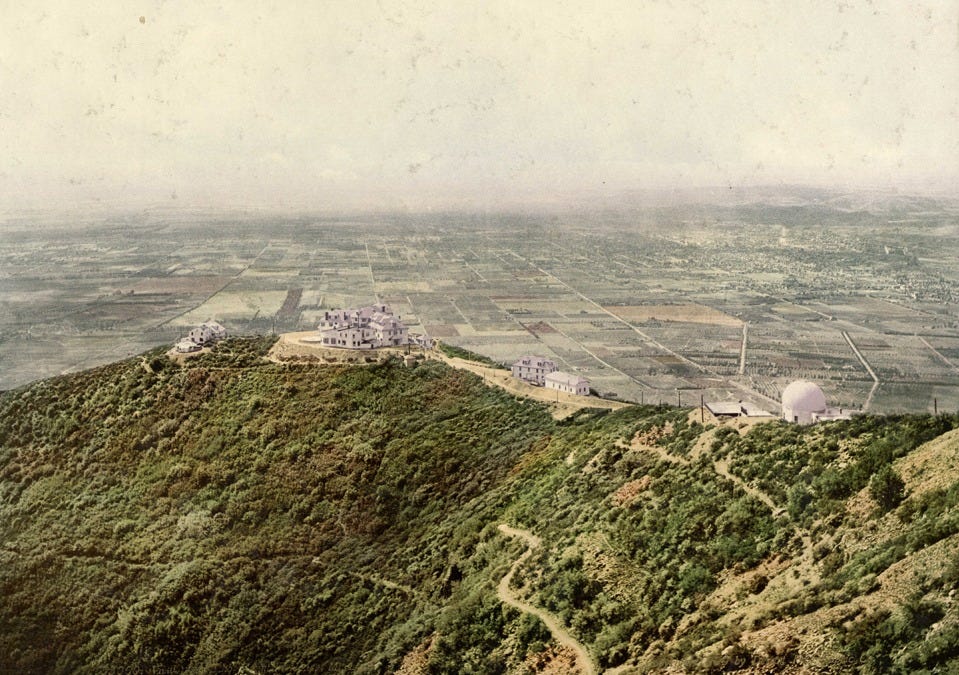
And where, in all of this, was Echo? The bird had not been with Leland when the old man collapsed at Castle Green, and had not been spotted since. He had flown—the distance short, but steep—back up to the nearby mountain whose name he shared. It was darker than the night sky, reflecting back only density under the pale flicker of moon and stars as Echo ascended its sage-scented silhouette up to the summit. (In those days, the stars still shone over the foothills and the valley, before an abundance of lights blotted them out of the sky and sent them into the concrete…)
Echo didn’t know what he hoped to gain from the perspective of gazing down at the dimmed valley. Atop the mountain were the ruins from the hotel that had perched with a bird’s eye view before burning down five years before, the calamity freeing the hyacinth macaw who’d lived in a cage in the foyer. The ruins still emitted the charred perfume of absence. Echo felt a similar void (of something burned and gone which had only just been there) when Leland collapsed. He had never expected he would find such friendship in the old man, but five years of camaraderie under the Monroes’ roof made Echo realize, in a panic, that there was very little left for him on Millionaire’s Row if Mr. Monroe was no longer there.
Echo also had to admit, albeit reluctantly, that his drawn-out attempts to woo the green parrot, Envy, had been unsuccessful. She had not let herself imagine what might lay beyond the confines of her cage. It had become apparent, after five years of trying to make things work, that they wanted different things. Echo conceded he may have been pressuring her too much from the start, as he was of a parrot persuasion that mated for life and sought this same commitment from a partner. He recognized it might be a lot to ask, especially when Envy only had the human example as her frame of reference. From what Echo had observed, humans were not like macaws in this way. At least, most of them weren’t. Most primped and preened like birds to attract a mate and made promises till death once they had one, but this was not guaranteed to be a happy outcome. Part of this, Echo knew, was because people had a confusing and harmful way of merging that thing called money into matters of utmost human intimacy. They ran the whole thing like a business, and had issues with equality, besides. The human pecking order made no sense to him with its value placed on a fleeting commodity, rather than merit or virtue or legitimate compatibility…
…Alas, the narrow-sighted nature of human ambition was a tangent which worked Echo into a state of frustration every time it crossed his mind.
With his sudden need to take flight that night and be up there alone in the crisp mountain air, Echo watched the shadows ripple all the way down to the grey line which marked the coast and realized that his eyes were starved of views. Before he lived in the Echo Mountain House, he had seen more of this earth than most of his kind. Macaws were not migratory birds, but because he had lived the precedent of a changed landscape, he had entered that cycle of the migratory and needed something different again. He had made a promise to himself to look after the family who had taken him in. As such, he would wait by Mr. Monroe’s side until his time came. And maybe just a little bit longer, because a new Monroe child had entered the story, and he wanted to be sure she would settle in alright. After that, he would let a wider horizon beckon.
Conviction puffing his chest feathers, Echo flew one last loop above the summit and plunged back down into the foothills, straight for Millionaire’s Row...
********
Leland Monroe was still alive and breathing and would be for a little while yet. But he would not leave his bed. Nor would Echo, his steadfast companion, once the blue parrot returned from his mountain stint, appeared at the windowsill, and settled on his usual perch at the foot of Leland’s bed.
Once fully conscious, Leland insisted that his family continue on with their lives, rather than waiting around for a flame to flicker out. He further requested all manner of officials come through the door—lawyers, and the like—and declared that the house should not be closed off to callers in anticipation of a mourning period that had not yet begun.
Because of this, business continued with the proverbial usual. Which was why, despite the dying man upstairs, a caller appeared at the doorstep the next afternoon. Expecting Dr. Wheatley, Scottie was surprised to find Jasper Lennox on the front step. She warned the two Miss Monroes who were out on the back terrace, dazed from sleeplessness and speechlessly absorbing the rising heat of Sadie’s second afternoon in the Monroe house. Sadie recalled, then, the proposition from the night before which she had entirely forgotten while worrying over Leland’s fate.
“Delia,” Sadie whispered, panicked. “I have to tell you something about Mr. Lennox’s plan...”
“Oh, I can very well guess,” Delia chirped. “Send him in, Scottie. We’ll be right there.”
Sadie gaped. “I thought you didn’t like him.”
“He’s not coming to call on me.”
“But he said he wanted a second chance.”
“I do admire a persistent heart,” she mused. “Come on. Nathaniel will be our chaperone.”
Their entry into the parlor echoed with merry, conspiratorial laughter. Jasper and Nathaniel were teasing each other in that languid, easygoing way of old friends. It was, most probably, the adult male iteration of earlier boyhood scuffles, that infectious, unfettered merriment of male freedom that confident young men were adept at pulling out of even the stalest, saddest air. The two seemed almost loath to accept the girls’ company when they came in.
“I hear you’ve come to call on Miss Monroe,” Delia smirked, her tone brazenly flirtatious.
“Ah, yes.” Jasper rose to his feet, the act drawn out with a strange reluctance. He approached the two young women and gave them both a pursed kiss on the back of a hand.
“This is going to get awfully confusing if you call her that,” Delia went on. “Her name is Sadie Reyes.”
Jasper gave a gallant little bow. “My apologies, Miss Reyes.”
He returned to his chair near Nathaniel as the two women sat across from them, side-by-side on a loveseat.
“I was just telling Nathaniel,” Jasper turned half away from the girls, “that they’ve spotted the cat again. Higher up in the foothills this time.”
“We ought to be organizing a hunt instead of sitting around here,” Nathaniel muttered.
“You can’t!” Sadie interrupted.
Jasper turned to her, amused. “Can’t we?”
“Sadie’s a woman of principle.” Delia offered.
Sadie shrugged. “I just don’t believe in senseless things.”
Jasper countered. “Then you’ve obviously never been in love before.”
The observation was such a deft change of subject, and so tersely unexpected, that Sadie held her tongue. She would not reveal in that moment that she suspected she did know that singularly irrational feeling called love. She would not admit it out loud yet—or probably ever—because she could not yet tell the difference between torrid infatuation and unconditional admiration.
“We’re like a family already, aren’t we?” Delia grinned into the confused speechlessness that fell over the room. “Teasing each other all the time. I do admit it would be a lot simpler, Jasper, if you married in.”
“Don’t you think I haven’t tried?”
Sadie admired the easy interactions between the three other people in the room. How familiar they were in each other’s presence. But she found it odd that Delia and Jasper should have such a gliding rapport after whatever might have happened the previous summer. It was odder still that Nathaniel had suddenly retreated into the same stiff comportment she recognized from the day before. The only difference was that he couldn’t make the muscles in his face force down the stubborn last corner of a smile that would not give way.
“I really came to propose…” Jasper proposed, reveling in the suspense his unfinished sentence gleaned before innocuously concluding, “that we all go into town. Just a stroll.”
“I’m afraid I cannot join you.” There was a hint of charade in Delia’s sigh. “I’ve got to stay here for calling hours.”
“You wouldn’t have to if you had not rejected me,” Jasper offered pleasantly.
“This is the one moment in life where I get to feel like a queen,” the golden girl parried. “Will you begrudge me the chance to have options groveling at my feet?”
“I cannot begrudge you that,” Jasper consented. “Will you permit us to go into town as long as Nathaniel serves as chaperone?”
“Oh, these formalities.” Delia laughed. “Enjoy yourselves. That is, Sadie, if you would like to go?”
“I would very much,” Sadie admitted. “Are you sure you won’t come?”
“There’ll be plenty of time to go together.”
Confused by the whole affair, Sadie wondered why Delia would not join them, and why the others would let her stay. Jasper had made it clear his designs were not on Sadie, anyway. But perhaps they all intended a thorough ruse, and strolling about town with Sadie would likely have such an effect. She was whisked towards the door between the two tall, dapper gents, feeling strangely à la mode, despite her disorientation, in the same pale green frock Delia had lent her the day before.
Delia herself hurried to retrieve a hat from her collection upstairs—a wide-brimmed, flower-trimmed confection—and returned to the entry to perch it atop Sadie’s head, fastening it in place with an assortment of long pins.
“You couldn’t leave without a hat.” She smiled triumphantly, then whispered, “You really don’t mind the ruse?”
“Not at all,” Sadie replied, still confused. “But I’d rather you joined.”
“It would be more suspicious,” Delia said cryptically. “I’ll make it up to you! We’ll go into town together very soon.”
Minutes after the three set off on foot, both gents claiming one of Sadie’s arms, the door chimed again.
Scottie, who had been lurking at her usual clandestine post in the corridor to listen in, hurried to the door in a huff. “I knew she should have taken a parasol...”
But she was surprised to find a different gangly figure clearing his throat on the other side of the threshold. “I’m here to call on Miss Monroe.”
Hesitant, Scottie led him into the parlor where Delia stood up to greet the unexpected guest. Her smile twitched in the effort to keep her expression from visibly distorting with confusion. Everett, too, stared at her in surprise.
“Have a seat, won’t you?” She asked him anyway.
“This is a bit embarrassing,” Everett stuttered, placing the book that had been tucked under his arm onto his lap once he’d claimed a chair. “I meant to be calling on the other Miss Monroe.”
“Oh, you mean Miss Reyes. She’s not yet a Monroe in name. You’ve just missed her. She’s out with my brother and Mr. Lennox.”
“Ah.” Everett nodded slowly, disappointment coloring his cheeks. “Should we not have a chaperone if we are to be here together?”
“Scottie’s just around the corner,” Delia smirked. “Isn’t that right Scottie?”
They heard a brief scuffle as the housekeeper made a show of pretending she was further away than she was. She appeared in the doorway with a feigned look of innocence. “What was that, Miss Monroe?”
“Would you stay nearby while Mr. Wakefield and I are chatting?”
“Of course,” Scottie nodded, only half-succeeding at hiding her grin—i was rare she was invited to sit in on conversations out in the open. She sat herself down in a faraway chair near the entry. “I’ll be right here.”
“Thank you,” Delia assented, returning her attention to the nervous young man across from her. She nodded towards the tome in his lap. “Is that for Sadie?”
“Last night I said I would lend it to her, but you all left in such haste that it was quite forgotten in the rush.”
“It was on account of my father.”
“Is he quite alright?” Something proper in his trans-Atlantic accent piqued Delia’s curiosity.
“He’s not well.” The consensus sounded far too benign after the nearly sleepless night she’d spent in his room with the others, willing the old man back to consciousness before she succumbed to exhaustion herself. She knew, of course, that he did not have much time left. But the suspense kept her from accepting the extent of what was to come. Denial was a pleasant enough balm and so she said simply, “I don’t want to be bothering you with all that.”
“It’s no bother,” Everett spoke hastily. “In fact, I think I understand your plight. My mother has not been well for a long time, either. That’s why we came here all those years ago.”
“Is it really?” Delia’s eyes watered. “I never knew. I remember when you first came to town though. You used to like more than mere books.”
“Well,” Everett mused uneasily, “they’ve never been difficult company.”
“Boys can be bullies, can’t they? Girls too, for that matter.”
“Yes.” Everett stared at the ground. “Especially when you’re different.”
“You’re not really interested in Sadie, are you?”
“Why do you say it like that?”
“I like gentlemen to be honest about their intentions.”
“My intentions are marriage,” Everett said. “I’ve made that abundantly clear.”
“You just seem a little overzealous is all.”
“Do I? I suppose that’s not very polite.” Everett chanced a glance upwards, but let his gaze waft far away as he continued, “It’s just that I finally met someone who gave me the slightest bit of courtesy, and laughed with me, and held my gaze, and I thought that might have meant something. So I’m here to find out—these kinds of things don’t come around very often for outcasts like me. And I know that sounds like I’m feeling sorry for myself, but it’s true. I think maybe people hold the Wakefields at arm’s length because it’s an old name and they feel slighted. But I hate saying that because I disapprove so thoroughly of this rivalry between old money and new and—” he stopped himself suddenly. “A thousand apologies, Miss Monroe. You know I have a tendency to ramble.”
“Quite alright, Mr. Wakefield. But I feel I should warn you that your efforts will be in vain.”
“How can you be so sure?”
“Because Sadie has confided in me that she wishes not to marry.”
“And yet she’s allowing Mr. Lennox to court her?”
“That’s a strong word. He’s an old friend of the family. He just wants the chance to know her.”
“Or to try for things again with you?” Everett stopped himself, bewildered by his boldness. Delia’s bemused expression forced his gaze back to the carpet. “I don’t blame him for trying.”
“Oh, Everett. I mean—Mr. Wakefield,” Delia said bashfully, surprised by the young man’s awkward candor, “if a woman rejects a man once he should know there’s a reason.”
“I imagine you have your pick of suitors, anyway.”
“They all fell away when Mr. Lennox started hanging around last year.”
“And now?”
“It’s no matter. I’ve been reconsidering my prospects lately.”
“Thinking of going abroad? I hear it’s still quite à la mode for heiresses to merge with the English nobility.”
“I mean no offense, Mr. Wakefield, but not all my designs are presently centered around marriage prospects. Once upon a time that may have been the case, but no longer.”
“A thousand apologies. I did not mean to assume.” The conversation slid to a halt at the brink of that dreaded chasm of silence…
…But instead of avoiding it, Everett had an epiphany.
The solution to transcending these strange pauses he so feared, was not, he suddenly realized, to babble through them. Rather, the key was to simply ask the other party a question.
And so, with tremendous relief, he let propriety give way to curiosity. “May I ask what you were referring to?”
“University,” Delia said, the answer gliding out without resistance. “I’ve been thinking I might like to give it a try. It’s not that I feel left out exactly, with all the girls from Miss Orton’s going off to do their four years in dormitories, but... I’m coming around to recognize that it is an opportunity, and these things should not be squandered.”
“I think it’s a marvelous idea.”
“You don’t think it would be futile?”
“Learning never is.”
“And if I still want a family... later won’t be too late, will it?” She stopped herself, wondering why she was voicing this most private concern to the awkward though not unpleasant bibliophile who lived down the street. Wondering, also, why it was so much easier to talk to people she did no know so well. Then wondering if some people, such as Mr. Wakefield, were simply easy to talk to.
Everett considered her words thoughtfully, not even realizing another silence had fallen between them. After some consideration, he concluded, “If you have a chance to do something for yourself, to expand your horizons, to live elsewhere and try something new, why not take the opportunity?”
Delia stared at Everett, charmed by his conviction. She was distinctly aware that in that moment she began to see him differently, and to feel the first hazy reckonings of understanding that would later coalesce into her own quiet conviction. But because it was all so sudden and unformed, she restrained herself to mere politesse.
“Mr. Wakefield, I am very heartened to hear someone say these things out loud.”
“I’m glad if I could offer a bit of encouragement, then.” Everett hesitated, never sure how to proceed when confronted with the tricky subject of modernity. “I am not the most modern of men. But I do think all people who have the chance to do something which might add dimension to their lives ought to pursue that to the utmost. It need not be education; that’s just a regimentation of the learning that life can be filled with. Travel might serve the same purpose. Have you travelled much, Miss Monroe?”
Delia sighed. “Father has never been well enough.”
“Then someday you must!” Everett insisted. “The world is full of different landscapes, and the more you see, the smaller this valley becomes each time you return.”
“Too small for you, Mr. Wakefield?”
“It is still home.”
“But your family is from the east, aren’t they?”
“I’ve spent most of my life here. Though I suppose I’ve never really thought of what home was. Mostly felt it. You know, in the familiarity and such.”
“Would you ever move back East?”
“It would depend on whether I found any prospects here.”
“So you don’t intend to remain a bachelor, then?”
“Would I be here if I did?”
They were both startled and yet not surprised to excavate the same conclusion in the meaning beneath his words. It trilled with the comfort of the inevitable, of glowing, reachable horizons and the safe, well-trod path of an imaginable destiny. Delia felt something supremely calm and comforting settle over her: the weightlessness of a decision making itself.
But then the clock chimed the half hour, startling them both.
“I didn’t realize how much time had passed,” Delia gasped politely.
“Nor I,” Everett admitted. “It has been most pleasant sharing your company.”
He hesitated, then, desiring to stay but realizing that propriety was asking him to leave. As he rose to his feet, he cleared his throat.
“Would you see that your sister gets this?” He handed Delia the book, the gesture feeling useless in the wake of their conversation. Delia smirked at the title.
“I never imagined you might be one for novels, Mr. Wakefield.”
“Are you, Miss Monroe?”
“I see we will have much to discuss on another occasion.”
Formality, then, enabled Everett to continue on his newly emboldened path. “Would you permit me to call again?”
Stunned and satiated all at once, Delia’s smile was decisive. “I would like that very much.”
The suddenness of their shared realization left them bashful and clumsy in their goodbye. As Scottie escorted Everett back out the door, Delia felt herself pinned down to her seat, confronted with an imminent choice, and the trilled thrill of things she could seize for herself. Things could seem so hopeless when they remained abstract, but they were not unimaginable. Suddenly she had a clear picture to replace the void that had been riling her uncertainties. It was so starkly definite that she could taste the sweet ochre of its horizon line. This was all the sweeter for its languid lingering—the inevitable left her in no haste.
********
Sadie, however, did feel quite rushed as she struggled to keep pace with her two tall, long-strided companions down Orange Grove and into the city.
“These houses are marvelous,” she said while she scuffle-stepped. She pronounced the word oddly, the emphasis on the second syllable, having only read it before but never said it out loud. And yet, it had come to her as naturally as breath to describe the resplendent structures that lined the wide, tree-lined street.
“They leave a open-mouthed first impression,” Jasper agreed, “but after a while you start to find them grotesque.”
“At least it’s not Summit Avenue,” Nathaniel reasoned. “Remember those months I spent in Saint Paul with an aunt who wanted me to marry the daughter of a railroad baron? Those brownstones are too weighted down with wealth. I’m becoming increasingly more inclined to the new Greene style.”
“That would be the Greene Brothers.” Jasper explained, as though implying that there was more than one would give Sadie a better understanding. “All those cloud lifts in Arts and Crafts.”
“They’re changing our perceptions of art and beauty,” Nathaniel said. “I find it very refreshing.”
“You’re so modern, Monroe,” Jasper chuckled, “especially in your conviction not to pair up with a railroad heiress. They’re around here too, you know. I don’t see why you had to go all the way back to the Midwest when the Huntingtons’ daughters are just across town. I rather like Elizabeth and Marian, don’t you?”
“You mock me, Lennox,” Nathaniel said good-humoredly.
“I’ll behave now,” Jasper ceded.
“What’s a cloud lift?” Sadie lifted her head to glance beyond her hat brim at the wide, unadulterated blue sky above them, with no clouds in sight.
“Do you have an interest in architecture?” Jasper queried.
“I don’t know.” She had only read about three pages worth of something called Italianate while in the midst of binding a series of architectural manuals.
“We’ll have to take you to one of Eva’s salons,” Jasper decided. “She always loves new and interesting people.”
Sadie’s gaze falling back to earth. “I don’t think I’m particularly interesting.”
Nathaniel raised an eyebrow. His usual coldness had thawed in the sunlight, and a warmly resigned acceptance entered his tone. “The waif who shows up on our doorstep with a letter from a mysterious woman from Father’s past and no preconceptions of this strange valley? I’d say you’re very interesting, even intriguing. Eva will be delighted.”
“You’ll have your taste of a proper soirée. Nothing posh and stifling like that ball last night.” Jasper’s eyes crinkled with mirth. “But we amused ourselves anyway, didn’t we?”
“I enjoyed myself,” Sadie replied. “But I hope you two aren’t planning to get me in trouble.”
“Good grief, Miss Reyes,” Jasper preened, feigning offense, “that’s no way to live.”
The three turned a corner, and Sadie stared avidly at the long stretch of Colorado Boulevard, the city’s main thoroughfare. The elegant brick and mortar façades suggested the usual eminence of human hubris, that hard-and-fast clamoring for legacy paired with the compunction that it must be erected quickly. Mankind was in an awful rush to get on with eternity—to lay claim, to leave a mark, to make a name. That is of little consequence to this part of the story, however, as Sadie was dazzled nonetheless by the busy street and the neatly lined shops on either side. These swallowed and regurgitated well-starched denizens in petticoats and top hats, equality melting all throes of status as they all perspired uniformly in the summer heat.
It was, of course, a city like any other, except this one was cradled by the mountains and fully formed out of the golden dust that drifted up with the cart wheels. Miles of dry land sprawled from the edges of town, waiting to be coaxed into fertility. But behind the storefronts, one could not squint into recent history and pick out the wild west. The land seemed too tame and civil and ripe with that ever-present fragrance of orange blossoms wafting in from near but unseen orchards.
“Marvelous,” Jasper grinned, gently stressing the first syllable. “How many towns do you know in the shadow of the mountains?”
“She’s not from the other side of the world, Lennox,” Nathaniel teased. “Father said you came up from Los Angeles?”
“Yes, I worked there.”
“A working city girl,” Jasper grinned. “How does this compare?”
Sadie contemplated the fresh storefronts, the dust coming off the road, the bustle she imagined was the same in any city. There was not the same industrial shadow, and the buildings weren’t quite as tall, but otherwise, it was hardly different. “Maybe it’s a bit newer,” she decided. “It looks like this all just sprouted out of the dust.”
“Maybe it did,” Jasper agreed merrily. “Progress is a most insistent mistress. Or at least we make her out to be.”
They traipsed down the sidewalk, Sadie walking a bit ahead of the other two as they strolled in good spirits, buoying up Sadie’s own steps with a bubbly brimming lightness as she admired all the shop fronts and window displays. She wondered how it was that Nathaniel could have become so amenable after being so resistant the day before, especially when they had spent the night in such bated turmoil at Leland’s bedside. Jasper did seem to have a merry effect on whomever he gave his attention to, and joy was all the more poignant when it herded sorrow. It was a relief to laugh—at nothing, everything—and to ignore that imminent darkness. And to accept the light which was there to define the shadows, no matter how imposing they became.
Sadie glanced back at the two men cutting similar silhouettes as they laughed again.
“It is rare that we have occasions to be out like this,” Jasper explained. “Usually, we’re off hunting or attending requisite luncheons—you know, the usual social drudgery.”
She didn’t know, but she liked thinking he thought she did.
“Funny how some moments of being on the ground can make you feel like you’re on top of the world,” he mused languidly.
“Why don’t we go up to the top?” Nathaniel suggested, eyes glittering with non-ordained folly.
Jasper grinned. “The mountain, you mean?”
“We’ll take the funicular.”
“The what?” Sadie asked, alarmed.
“An excellent idea!” Jasper affirmed. “You couldn’t get a better view from New York!”
Jasper and Nathaniel’s casually cosmopolitan airs left Sadie pleasantly breathless. They spoke of faraway places in a way that made them seem near. They had been formed with the well-greased hinges of an easy life, and it made everything they did, even spontaneous whims, seem smooth and effortless. What she liked the most was their unjaded enthusiasm. They had never had to curtail anything, and so Sadie drank up their smiles and vivacity and the sunlight which had been there smiling through these unshadowed souls all along. Without hesitation, she followed them northward, towards the sleeping beasts that formed the looming mountains beyond.