

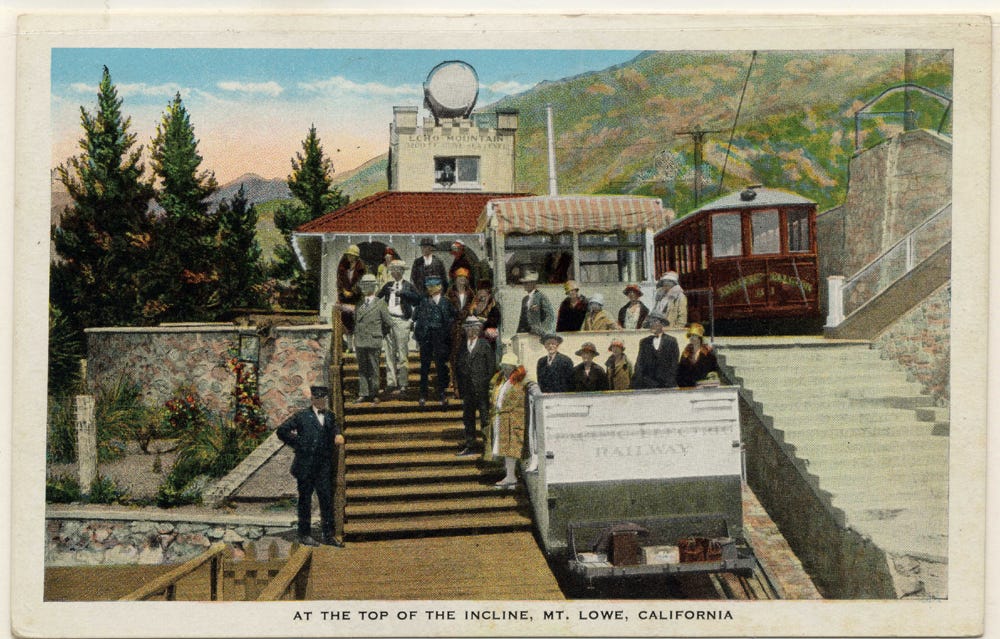
There was a streetcar waiting down Colorado Boulevard. It was bound northward, glistening red and gilded with the letters of Pacific Electric emblazoned on each side. The trolley Sadie rode up from Los Angeles only the day before had also been a Pacific Electric vessel. These were a common sight and a smattering of color on major thoroughfares between Los Angeles and its foothill cities to the north. A man named Huntington held their monopoly, which made him another west coast millionaire with riches to rival Carnegie and Vanderbilt. The trolleys, powered by electricity, were the link between the foothills and the larger rail networks that had stretched to tame the entire continent under the weight of iron and steel.
Given a window seat, Sadie stuck her head out of the opening, marveling at life’s capacity to cut suddenly and jaggedly away from straight lines. The street car’s route, however, was perfectly linear, taking them past town and then through the fields a few miles north. It was late for the poppies, but there was still a smattering of marigolden blooms just below the mountains. The streetcar window framed strokes of orange and gold that fused with the green peeking through.
The ride took them to Rubio Canyon, just below Mount Lowe, named for another locomotive man who had put his fortune into constructing a mountain track network, including the ascent awaiting them. The tracks ascended vertically at a steep grade, scaling directly up the mountain face at a 62 degree angle. The vessel that would transport them upwards was an open-air funicular, paused at the base of the mountain to board passengers. With three levels open to the elements, and a low railing at each, it promised a vertiginous ascent which would transpire over the course of six agonizing—breathtaking—minutes.
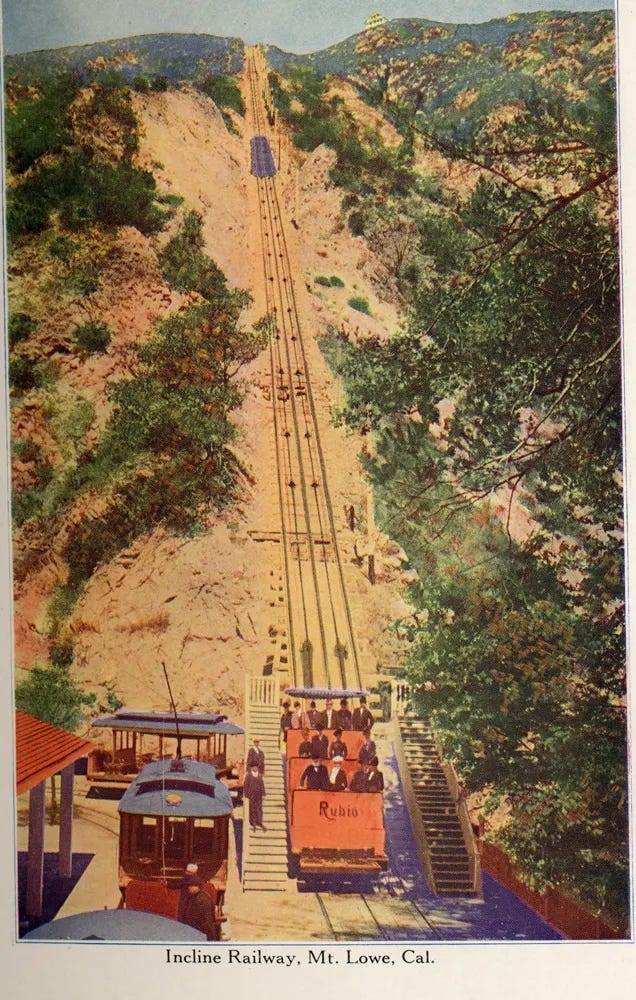
“How’s that for an opera box?” Jasper joked. Sadie did not quite know what he meant, as she had never been to the opera.
“That’s how we’re getting up,” Nathaniel explained, grinning, as Sadie stared open-mouthed at the contraption.
They had to cram into the car, a quantity of people which seemed far too dense for the small funicular opera box, but no one seemed concerned about the weight which was about to travel up such a height. Nathaniel escorted Sadie to the lowest level which had the clearest view of the valley. The three squeezed in together and soon the little box moved upward, diagonally, at an angle that defied nature, logic, and all possible human feelings of safety. At first, Sadie hid her eyes from the view, a sweltering vertigo threatening to pound the borrowed hat off her head.
“Don’t close your eyes!” Jasper urged. “The view’s better than any fear you might be feeling.”
She didn’t believe him, but she listened. She opened her eyes, felt her head leer as she grasped the top of the railing, and watched the valley fall away while her body fought against gravity. She felt the ascent pull her heart into her throat and was wracked by a suffocating sense of distance—a helpless, all-encompassing breathlessness.
“Isn’t it something?” Jasper asked.
“It’s something,” Nathaniel agreed.
The two were banking on Sadie’s eyes staying glued to the rapidly descending scenery as their gradual swoop upwards heightened the pressure in her head. But they hadn’t accounted for the shock of glee which overcame her once she’d accepted that the ride would be smooth.
She turned towards them, suddenly, eager to match her strange-feeling smile to the merriment on someone else’s face. But she found only bewilderment mirrored back upon glimpsing Nathaniel’s hand placed gently on Jasper’s shoulder. He remedied the gesture by patting Jasper boyishly on the back and murmuring preeningly, “This was an excellent idea, Lennox.” But there was something suddenly less fluid in their interactions. Uncertain of what was the matter, Sadie turned back to the view and squinted towards the horizon and saw waves of green and gold stretch all the way to a dark and distant blue. A haze hung over the coast, offering a greyish mist between a visible reality and the unknown or unacknowledged beyond. That grey churned something murky in Sadie’s soul into a crisp stream of clarity.
Maybe people were simple in their profundity, she thought, if all it took was finding a high place to look down upon a situation in order to gain some semblance of perspective. Maybe seeing how small the world could look from afar made its hills and valleys seem surmountable. And of course, the haze rimming her own thoughts and feelings came from a sustained disbelief that she should be precisely where she was. Time had been a persnickety ally. How could it be possible to forget nineteen years in one afternoon? How could rewriting one’s destiny—overriding one’s past—be so immediate and omnipotent? There was a blessed curse in the efficiency of human adaptability.
As they continued to rise, Sadie began to see a world larger than she had ever known. The same straight streets she’d traversed with Jasper ad Nathaniel stretched all the way to the edge of the continent, or perhaps even the edge of the world, which was veiled in the haze and mystery that hovered above that faraway blue. Though the haze obscured the distinction between sea and sky, the mountain beneath them was more real than it had ever been while gazing upon it from below to pick out the outlines of slumbering griffins curled up protectively against the valley.
It was Califia’s view. Something regal and queenly settled over the crown of mist ringing the valley and the coast. From so high above, one could see things from beyond—or at least outside of—a human perspective. This was the territory of the gods or the guardians, and it felt as sanctimonious as it felt sacrilegious to tread upon their unsettled earth. It was easier to feel that from up above, Sadie figured, as being on the ground gave less of a sense of the dust beneath the civilization constructed on top of it, or the lives that had come first, or the natural way of things. What was California but an idea, a corner of a continent fought for and won by players in a game of ownership and make believe. Made-up laws had written it into Statehood, as part of a country that was just another penned set of values applied conditionally to a select, bloodthirsty brotherhood. Califia and her bountiful, fecund fields and valleys had been far too obliging. Sadie wanted a different fate for the Amazon queen, for the griffins to rise up and fight for the land back, for its laws to be absolved.
She was stunned, then, to find an act of vengeance at the top of their mountain ascent. The funicular stopped at a plateau just beneath a series of peaks, and its passengers filed out, their exit confronting them with a view of charred ruins atop a large, concrete foundation. Many of the other passengers passed these ruins to board another trolley, which would take them further up the mountain. But Jasper and Nathaniel made a turn for a set of concrete stairs leading up to the foundation of a building that was no longer there, stopping at the invisible entry that had since burned away. Skirts gathered up inelegantly in both hands, Sadie stopped at the base of the stairs. From that vantage point, they seemed to lead nowhere but the cloudless sky.
She felt a whoosh of wind inside her head as the valley a far fall below called from the corners of her vision. She had never been so close to the sky before. Up there in the blue, she could feel its benevolent wisdom, that calm oblivion hovering above humanity to suggest infinite imaginings of a reachable beyond. Protector or menace, it could not be ignored while so high in the air.
“We came up here sometimes before it all burned,” Jasper said. “Some marvelous parties!”
“This was the foyer,” Nathaniel called from further along the concrete blueprint of what once had been. “There was a doorman to greet us. And a parrot on a perch.”
“He bore a striking resemblance to your father’s parrot,” Jasper smirked.
“Echo came to us of his own accord.” Nathaniel chuckled, eyeing Sadie curiously. “Did you know they call this place Echo Mountain?”
Sadie stepped up to join them both on the charred foundations of a large rectangle, the remnants of a structure she could imagine but not quite fathom. “It doesn’t seem very big for a grand hotel.”
“The foundation is a bit deceptive, I suppose.” Jasper shrugged. “It wasn’t the Ritz, but you can’t build the Ritz on the backs of donkeys, now can you?”
The ghost of the structure began to take form, slightly—luscious carpets and wicker chairs and sweet, alpine breezes through open, lace-curtained windows with views of the valley far below. All to the tune of an orchestra playing all-night parties to keep the wild animals away. It must have been a splendid hotel with a marvelous view, but Sadie felt secretly glad that it had burned up. No one should have been able to gaze upon that vista from the comfort of a cushioned room. It was a view that ought to be earned if it was going to be enjoyed at all—not a playground, but a place of perspective. Hammering stakes and rail ties into the mountain—innovative as the engineering was—seemed, somehow, worse than doing it on the valley floor below the foothills. Sadie had a distinct sense that she was witnessing a failed last push to defy nature’s sovereignty. It had been a bated act of hubris, Nathaniel explained, which sabotaged itself through bankruptcies on a dream and, later, in the heat of a kitchen fire which burned everything to the ground.
So Califia’s last defenses were working on something. Sadie felt a strange relief come over her then, but realized she had been lost in thought for a few moments too long. Jasper had just posed a rhetorical question about donkeys and the Ritz. She tilted her hatted head up towards him. “What is the Ritz?”
“Oh, just some grand hotel in Paris,” he said. “But they’re all the same, really. You can have champagne and caviar for every meal of every day, but a view of some bloodstained old cobblestones simply doesn’t compare to this mountain air. Is that sage not intoxicating? It’s the whole history of the earth in one sniff. Makes you feel time differently, doesn’t it?”
Sadie inhaled the fresh mountain air and those whispers of sage and felt all that was immortal in the dry earth beneath her feet. And as she exhaled, the wind whipped up the dust covering the foundation upon which she stood and she had an even clearer vision of the building that had been there before. And the workers who had ascended the mountain leading pack mules laden with building materials. And the travelers who had erected the town below that provided the workers. And the valley that had been pinned down beneath the weight of settlement. And the trains that had brought those people with their myriad reasons for coming west.
She saw as many people escaping as they were laying claim. And among them, all of them the same shape and size from so far above looking down through the dust, she saw her mother.
Lenora, down there, with all that perspective and time filtering her pinpoint person into its truest essence, was not the sick woman whose life had slowly shuttered to a close in a small, dim apartment in a dark corner of Los Angeles. Down there, far away, she was as seasonally free as the poppies covering the hillsides in their shimmering gold. Free from the corseted clauses of life in the east, but bound to the land, working the fields every day of the harvest. The rancho had made her one of many victims of the land’s bounty. There was always something to reap.
She had found it funny—Lenora, that is—how a dream could shift with a perspective. She’d dreamed of wedding any of the strapping generals in livery who passed through the house to convene with her father, a tantalizing escape from the repetition of her agricultural inheritance. But she might never have dreamed such a dream if she hadn’t overheard her parents discussing the prospect of these prospects quietly by candlelight in her father’s study. Was it that a dream could coalesce as an acceptance of an unavoidable fate? This dream gave context and momentum to Lenora’s days in the fields—an out, someday, and sooner than later—until the bandits passed through. They were plentiful in those days, while California was changing hands from one government to the next, transforming laws into wishes.
The rancho did not go untouched. When the bandits passed through to pillage the house, Lenora’s father was away on business, and she had been out tending to the cattle. She managed to escape their clutches because her mother did not. They had already done their damage by the time Lenora arrived to chase them off with her father’s hunting rifle. They escaped with the family savings and her mother’s dignity, and nothing was ever quite the same afterwards.
Lenora wanted nothing to do with men after that, nor could she find any solace in the freedom of lawlessness. So many of the settlers in the west, when left to their own lusts and fancies, seemed all too willing to disregard all proprieties and attack. Approaching womanhood, Lenora began to crave civilization, the mythical, structured society so far away in the east, where there were rules and laws and therefore possibly even consequences for evil acts. Stranded at the western edge of the continent, the only home she knew, Lenora would often climb the hills to look towards the nearby coastline (a view similar to the one Sadie had just discovered) and consider all possible beyonds.
Strange, then, that Lenora should find herself in a greater land of lawlessness by heading to Virginia City when she got the chance. She had always intended to go east, as far east as the continent would take her. Eventually, after Rebecca’s fate and Leland’s departure, she made it.
But she wondered long and hard, after leaving Rebecca’s haphazard grave behind, whether anyone would want the same things if these weren’t expected of them. This she began to mull over every time she attracted a man’s attention. Was she supposed to enjoy the admiration? To relish his not-so-secret desire to take her alone to a dimly-lit place? Was she missing out on some fundamental magic by not pursuing this union of two parts into a new configuration? She had seen too much too young to be easily swindled by a rosy-eyed romancer with sweet words and saccharine promises. She might have thought she’d been in love with the miner, Monroe, but she felt some murky chill up her spine when considering that his companionship would inevitably have been besmirched by the same desires in other men’s more leering stares. That was why she had encouraged Rebecca to seduce Leland. To see if there was only one thing behind his intentions.
It was an impossible reconciliation to consider sex and love, love and marriage, marriage and law. All of them had become tied up together to render the most intimate the least significant. Once she’d made it to the East Coast, Lenora realized that this was what civilization did, binding up the most intimate human acts in a chain of decrees and ownership. Not only was it difficult to escape this cycle, it was expected that all denizens should conform. If she had, by choosing marriage, she would have been limited to the permission or sponsorship of a husband. Property, bank accounts, all the logistical foundations of independence... it was all less old-fashioned in the west.
No matter where she ended up, Lenora’s desires seemed to contadict her circumstances. While in the East, she began to crave the lawlessness again. She was afraid of it too, but at least, out West, there was more freedom to choose. This was, in the end, what happened when the rancho foreclosed after her father’s death. She chose to be an unmarried woman, a working woman, an unmarried, working mother. And she was content to have decided a fate for herself. Before the illness set in, that is. The illness she contracted in the East—she was sure of it—while briefly employed in a damp textile factory full of coughing, depleted spirits. It was the illness of a civilization sick with grey ideas and automated destiny. After abandoning the factory job, she had found herself on a boardwalk facing the Atlantic—the extravagantly opposite view from her hills looking out upon the Pacific coast—and wondered with a bitter ache in her heart whether it mattered that no one else might want what she wanted, whether the safe choice was the best choice, whether she could survive the scrutiny for allowing herself to choose.
That might have been what it came down to in the end. Those who had followed the status quo were affronted by those who had the courage to choose something different. Lenora had not known what the grail was for her. She only knew, after seeing the opposite coastline, that she wanted her life to feel like the view from the poppy-covered hillsides that gave way to the Pacific, like the paradise ruled by Queen Califia before men and matrimony conquered her warrior women. And for a time, it was this way…
…Sadie, meanwhile, was in the process of realizing the peculiar tragedy of many relationships, that people who knew each other did not always have the privilege of truly knowing. She recognized, in that pinpoint version of her mother down there in the immortal valley, that she would never know Lenora. Nor, despite her private suspicions, did she know for certain whether she was a Monroe. She also didn’t know if she was someone playful or reserved. She had opted for the latter to avoid backlash at the bindery, but choosing to be a certain way was another matter entirely. Glimpsing her two companions’ contagious, cavorting banter on that mountain plateau with a view of the Pacific, she wanted to try and be like them and see if it felt more like her.
She scurried after them. They had clambered over the ruins towards a gulley on the back side of the plateau. There, they stood looking out at the rest of the mountain range looming beyond, both of them small against such an imposing height, the boyhood versions of the men they’d begrudgingly become.
Jasper cupped his hands over his mouth and yelled towards the other mountain, “Hello!”
The sound echoed back his voice, concentric ripples that grew fainter with each repetition.
“Monroe!” He yelled again, the phrase once again bouncing off the rockface.
“Lennox!” Nathaniel yelled back, the name following as they turned to see Sadie approaching.
“Sadie!” Jasper yelled out, and her name, too, echoed back.
“What?” She called out, her words reverberating until she’d caught up with them. “Is this why they call it Echo Mountain?”
“Not very original, is it?” Jasper mused. “Go on, try it for yourself.”
“How?”
“Just yell into the gulley. Yell at the mountain. Start with hello.”
“Hello!” Sadie yelled, breathless from the echo that swung back at her.
“Echo!” Nathaniel called.
“We’re here!” Jasper yelled.
“We’re here!” Sadie and Nathaniel called out in unison, all three voices resonating in a waltz of call and response.
Sadie could feel the mountain stirring. The griffins heard their cries. Something cast up a rustle through the pines and conifers sprawling in a blanket of green over the golden hills turned silver with altitude. Something had awakened.
“Califia!” Sadie yelled. “Califia, are you there?”